
Radial Head Prosthesis for Elbow Dislocation – When Is Surgery Necessary ?
Elbow dislocations are not uncommon, especially after a fall on an outstretched hand or a direct impact during sports or accidents. In many cases, the joint can be put back in place without surgery. However, things get more complicated when the radial head is also fractured.
The radial head plays an important role in keeping the elbow stable, especially during rotation of the forearm. When it is badly damaged, simply reducing the dislocation may not be enough to restore normal function.
When a Simple Reduction Is Not Enough?
In straightforward elbow dislocations, closed reduction followed by immobilization often works well. But if the radial head is fractured into multiple pieces, the situation changes.
Small cracks or minimally displaced fractures can sometimes heal without surgery. The concern arises when the fracture is severely comminuted, meaning the bone is broken into several fragments. In such cases, fixing the bone with screws or plates may not provide reliable stability.
If the radial head cannot be reconstructed properly, leaving it untreated can lead to joint instability, stiffness, or even long-term dysfunction.
Role of Radial Head Prosthesis
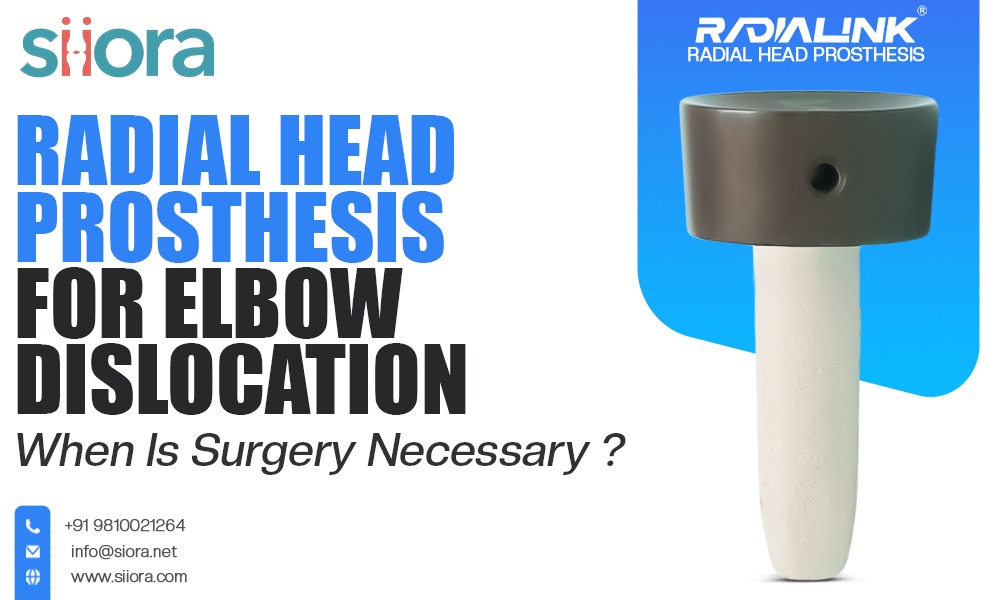
This is where a radial head prosthesis becomes relevant. Instead of trying to fix a badly shattered bone, the damaged radial head is replaced with an artificial implant. The goal is simple: restore stability and allow smooth movement of the elbow.
A radial head prosthesis helps maintain the normal alignment of the joint and supports the surrounding ligaments. It also prevents complications such as proximal migration of the radius, which can affect the entire forearm mechanics.
Key Situations Where Surgery Is Considered
Surgery using a radial head prosthesis is usually considered in specific situations rather than all elbow dislocations.
It is commonly recommended when:
- The radial head is fractured into multiple, non-reconstructable pieces
- There is an associated ligament injury causing instability
- The elbow remains unstable even after reduction
- There are combined injuries, such as coronoid fractures
In these cases, replacing the radial head often provides better results than attempting fixation.
What Surgeons Usually Look For?
The decision to proceed with a prosthesis is rarely based on a single factor. Surgeons assess the overall stability of the elbow, the quality of the bone, and the patient’s activity level.
For example, in younger patients, there is often an attempt to preserve the native bone if possible. But when stability is at risk, replacement becomes the safer option. In older patients with weaker bone, prosthesis use is often more straightforward.
Recovery and Expectations
After surgery, early movement is usually encouraged to avoid stiffness. The presence of a stable prosthesis allows controlled rehabilitation, which is important for regaining function.
Most patients can expect a reasonable range of motion if the procedure is done correctly and followed by proper physiotherapy. However, like any surgery, outcomes depend on the severity of injury and adherence to rehabilitation.
Final Thoughts
Radial head prosthesis is not required for every elbow dislocation. But in cases where the radial head is severely damaged and joint stability is compromised, it becomes an important option. The focus is not just on fixing the fracture, but on restoring function and preventing long-term complications. For the right patient, at the right time, it can make a significant difference in recovery.To explore a world-class range of Radial Head Prosthesis, RIGIFIX, by Siora Surgicals Pvt. Ltd., visit booth Y23 at the premier WHX Miami 2026.
Elbow dislocations are not uncommon, especially after a fall on an outstretched hand or a direct impact during sports or accidents. In many cases, the joint can be put back in place without surgery. However, things get more complicated when the radial head is also fractured.
The radial head plays an important role in keeping the elbow stable, especially during rotation of the forearm. When it is badly damaged, simply reducing the dislocation may not be enough to restore normal function.
When a Simple Reduction Is Not Enough?
In straightforward elbow dislocations, closed reduction followed by immobilization often works well. But if the radial head is fractured into multiple pieces, the situation changes.
Small cracks or minimally displaced fractures can sometimes heal without surgery. The concern arises when the fracture is severely comminuted, meaning the bone is broken into several fragments. In such cases, fixing the bone with screws or plates may not provide reliable stability.
If the radial head cannot be reconstructed properly, leaving it untreated can lead to joint instability, stiffness, or even long-term dysfunction.
Role of Radial Head Prosthesis
This is where a radial head prosthesis becomes relevant. Instead of trying to fix a badly shattered bone, the damaged radial head is replaced with an artificial implant. The goal is simple: restore stability and allow smooth movement of the elbow.
A radial head prosthesis helps maintain the normal alignment of the joint and supports the surrounding ligaments. It also prevents complications such as proximal migration of the radius, which can affect the entire forearm mechanics.
Key Situations Where Surgery Is Considered
Surgery using a radial head prosthesis is usually considered in specific situations rather than all elbow dislocations.
It is commonly recommended when:
- The radial head is fractured into multiple, non-reconstructable pieces
- There is an associated ligament injury causing instability
- The elbow remains unstable even after reduction
- There are combined injuries, such as coronoid fractures
In these cases, replacing the radial head often provides better results than attempting fixation.
What Surgeons Usually Look For?
The decision to proceed with a prosthesis is rarely based on a single factor. Surgeons assess the overall stability of the elbow, the quality of the bone, and the patient’s activity level.
For example, in younger patients, there is often an attempt to preserve the native bone if possible. But when stability is at risk, replacement becomes the safer option. In older patients with weaker bone, prosthesis use is often more straightforward.
Recovery and Expectations
After surgery, early movement is usually encouraged to avoid stiffness. The presence of a stable prosthesis allows controlled rehabilitation, which is important for regaining function.
Most patients can expect a reasonable range of motion if the procedure is done correctly and followed by proper physiotherapy. However, like any surgery, outcomes depend on the severity of injury and adherence to rehabilitation.
Final Thoughts
Radial head prosthesis is not required for every elbow dislocation. But in cases where the radial head is severely damaged and joint stability is compromised, it becomes an important option. The focus is not just on fixing the fracture, but on restoring function and preventing long-term complications. For the right patient, at the right time, it can make a significant difference in recovery.To explore a world-class range of Radial Head Prosthesis, RIGIFIX, by Siora Surgicals Pvt. Ltd., visit booth Y23 at the premier WHX Miami 2026.
 Siora Surgicals Pvt. Ltd.